
A Beginner's Guide to Starting a Digital Grimoire
A lot of beginners spend months collecting candles, crystals and tarot decks before they write down a single thing about their own practice. The tools feel like the practice. They’re not. A grimoire is what turns a bunch of experiments into something you can learn from, and the sooner you start one, the more useful it gets.
What a grimoire is (and isn’t)
A grimoire is a personal record of your practice. It’s not a rulebook, and it doesn’t have to be a big book of correspondences handed down through a tradition. It’s yours. It’s where you write down what you did, what you noticed, and what seemed to matter.
That sounds simple until you sit down to start and aren’t sure whether to copy out herb meanings or write about the dream you had Tuesday. The answer is both. They just do different jobs.
The reference side is stuff you look up: herbs, crystals, deities, tarot meanings. The journal side is what you actually did with all that. A lot of people end up with one notebook for each, and then neither one is complete. It helps to keep both in the same place, organized so you can find things.
What to write down
Spells, dreams and tarot readings are the three most common kinds of entries, and each one captures something different. A spell entry is about your intention and what you did. A dream entry is about images and feelings. A tarot entry covers the cards, the question you asked and what you made of it. Keep them separate enough that you can look back at them later.
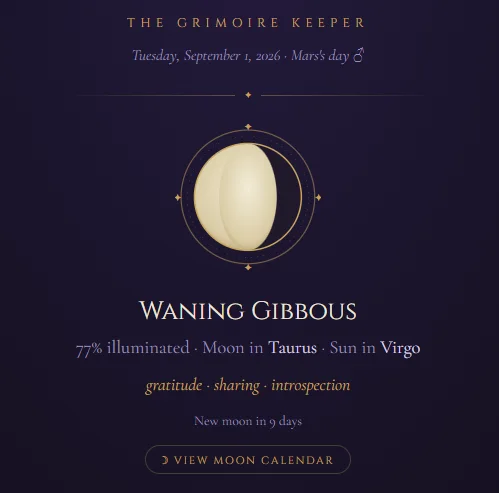
Write down more than the date. Moon phase, planetary hour and season all start to matter once you’re looking for patterns. The problem is that looking those up every time is tedious, so most people stop within a week. Grimoire Keeper adds that info for you automatically when you make an entry, including the moon phase and moon sign. It feels like a small thing at first. A few months in, it’s the info you’ll be glad you have.
Keep your reference library close
Stopping in the middle of a ritual to look something up breaks your focus at the worst moment. Having a reference library in the same place you journal fixes that. Grimoire Keeper has a searchable library of herbs, crystals, tarot and deities, so you don’t have to leave the app.
Astrology gets more personal than most beginners expect, too. A daily horoscope is written for your sun sign, which is just one part of your chart. Grimoire Keeper uses your birth info to build your natal chart and gives you daily notes based on it. If you don’t know what to look for in the sky yet, that takes a lot of the guesswork out.
What happens after a few months
Writing things down is only half of it. A pile of entries doesn’t teach you much on its own. The learning comes from seeing them side by side and noticing things, like your dreams getting more vivid around certain moon phases, or your readings changing with the seasons. That’s the real payoff of keeping a grimoire, and it’s hard to do by hand once you have more than a few dozen entries.
Grimoire Keeper looks across your entries over time and points out patterns from your own practice. Not general advice about what full moons mean, but things it notices in what you’ve recorded.
Starting a grimoire feels like a small decision. It turns into something bigger once you have enough entries to look back on. If you want a place to start, Grimoire Keeper has a free plan.
Want help putting this into practice? Book a free check-up.