A Beginner's Guide to Starting a Digital Grimoire Practice
Most beginners spend months collecting candles, crystals, and decks before they write down a single observation about themselves. The tools feel like the practice. They're not.…
By Cryptid Studio
Most beginners spend months collecting candles, crystals, and decks before they write down a single observation about themselves. The tools feel like the practice. They're not. A grimoire is what turns scattered experiments into something you can actually learn from, and the sooner you start one, the more useful it becomes. This guide covers what a grimoire actually is, what belongs in it, and how to build the habit without it becoming its own source of overwhelm.
What a Grimoire Actually Is (and What It Isn't)
The working definition most beginners skip past is this: a grimoire is a personal record of your practice. Not a rulebook. Not a published tome of correspondences passed down through traditions. Those things exist and have their place, but your grimoire is yours — it documents what you did, what you noticed, and what seemed to matter. That distinction sounds obvious until you try to start one and realize you're not sure whether to copy out herb meanings or write about the dream you had Tuesday.
The answer is both, but they serve different functions. The reference side of a grimoire covers material you want to look up: herbs, crystals, deities, tarot card meanings. The journal side covers what you actually did with any of that material. Most practitioners end up keeping these separately by accident, one notebook for notes and another for rituals, and then neither one is quite complete. Keeping both functions in the same place, organized so you can find things, is the thing worth building toward from the start.
What Belongs in Your Grimoire Entries
Spells, dreams, and tarot readings are the three most common entry types, and each one captures something different. A spell entry is about intention and action. A dream log is about imagery and feeling. A tarot reading log tracks the cards drawn, the question asked, and what you made of the answer. Mixing all of these into a single undifferentiated stream of text isn't wrong, but it makes the entries nearly impossible to revisit usefully six months later.
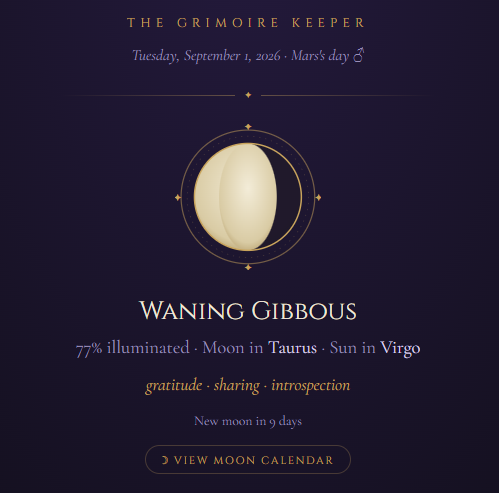
Timestamps matter more than most beginners expect, and not just the date. Moon phase, planetary hour, and season all become relevant when you start trying to interpret results or notice patterns. The problem is that logging this context manually requires looking things up every single time, which is tedious enough that most people stop doing it within a week. Grimoire Keeper handles this automatically, attaching real astronomical data to each entry at the moment it's created. Moon phase, moon sign, and more, recorded without the practitioner having to think about it. That detail feels minor at the start. Six months in, when you're looking across entries trying to understand why certain workings landed differently, it's the data you'll wish you had from day one.
Building the Reference Habit Alongside the Journal Habit
Looking up a correspondence mid-ritual and losing your focus is a genuine workflow problem, not a minor inconvenience. It breaks concentration at exactly the wrong moment. Having a built-in reference library inside the same tool you're journaling in removes that friction entirely. Grimoire Keeper includes a searchable library covering herbs, crystals, tarot, and deities, so the lookup stays inside the same context as the rest of your work.
Astrological context gets more specific than most beginners realize. Generic daily horoscope content is written for a sun sign, which accounts for one placement out of many in a natal chart. Grimoire Keeper computes personalized natal chart data from your birth information and uses it to generate daily counsel that's actually calibrated to you. For beginners who don't yet know what to look for in a given day's sky, that daily digest removes a significant amount of guesswork. You don't need to understand every placement to benefit from knowing which energies are worth working with today versus which ones might need more patience.
The Part Nobody Talks About — What Happens After Months of Entries
Consistent logging is only half the work. Raw entries sitting in a notebook or an app don't teach you much on their own. The learning comes from seeing them in relation to each other, noticing that your dream entries cluster around specific moon phases, or that your tarot readings shift in tone during particular seasons. That kind of pattern recognition is the actual payoff of a grimoire practice, and it's almost impossible to do manually once you have more than a few dozen entries.
This is where Grimoire Keeper does something most journaling tools don't attempt. It analyzes your entries over time to surface personal correspondences and trends specific to your practice. Not generic advice about what full moons mean, but observations drawn from your own recorded experience. That shift, from following general guidance to seeing patterns in your own data, is where the practice stops being something you read about and starts reflecting how your specific energy, timing, and intentions actually behave over time.
Starting a grimoire feels like a small administrative decision. It becomes something more substantial once the record is long enough to talk back to you. Beginning with a tool that captures the right context from the first entry, astronomical data, personal chart, searchable references, means you're building toward that payoff from day one rather than wishing you'd kept better records once you're already months into the practice. Grimoire Keeper was built specifically for this, keeping everything in one place so the habit stays sustainable and the data stays useful. If you're ready to start, it's at https://grimoirekeeper.com (opens in a new tab).
View the case study: https://itscryptidstudio.com/products/grimoire-keeper